Feasibility of solar electricity in Sri Lanka   By Srilal Miththapala & Suranga Karavita By Srilal Miththapala & Suranga KaravitaAn overview of the state of Solar PV installation in the Sri Lankan hotel industry was carried out recently by the SWITCH-Asia Greening Sri Lanka Hotels programme project team. While doing this study, the project team also analysed the impact of the proposed electricity increases on domestic Solar PV installations as well. A ready reckoner feasibility chart for evaluating financial feasibility of Solar PV installations for residences was also prepared. The following paper discusses these aspects. Introduction Of late, there has been much discussion about the generation of electricity from solar energy. This is usually called solar photovoltaic generation (Solar PV), where an array of solar cells, typically mounted on the roof of a building, will capture the solar energy and transform it to electrical energy. In a conventional or standalone system, the solar electricity has to be stored, since usage (demand) does not always coincide with supply (generation). Hence, in a typical installation, electricity is generated in the form of direct current (DC) and usually stored in batteries. The size of such battery banks required will depend on the size of the installation and the days for which the system can operate on battery power alone, with no input from other generation sources. In addition, the system requires an inverter to convert the electricity stored in the battery in the form of direct current (DC), to alternate current (AC) at a higher voltage, to be compatible with the downstream installation. The cost of a battery bank can be as much as a Solar PV panel for a well-designed system, which can provide power for several days when the Solar PV is not generating electricity. Batteries are still in the development stage and they are prone to premature failure. So, it is common that in Solar PV installations with a battery bank, some of the batteries have to be replaced before the specified lifetime. Cost of installation The high cost of Solar PV panels and the large amount of batteries required for storage resulted in the cost of such installations being prohibitively high and not feasible for installation as alternate energy sources.  With rapidly increasing electricity rates, reduction in price of Solar PV panels and acceptance by the Ceylon Electricity Board (CEB) to trade electricity units with the grid, Solar PV installations are at present becoming more financially attractive. ‘Trading’ of electricity This ‘trading’ of electricity units, recently allowed by the CEB, is referred to as net metering or grid tie. This is where an electricity consumer is able to generate electricity at the consumer’s own premises, using any form of alternate energy source and can then synchronize the electricity thus produced with the CEB system and ‘export’ it to the CEB.  Figure 2 – Solar PV installation with ‘grid tie’ system The consumer is not paid for this ‘exported’ electricity but is given credit (in kWh), which is set off against his normal electricity consumption off the grid. There will be metering for consumption as well for export of energy to the CEB network. Each month, consumption and export of energy will be compared. If the export is more than the consumption, credit is given (in kWh). If consumption is higher than export, the consumer is charged for net amount of consumption (consumption - export). This is effectively a ‘win-win’ situation for both the consumer and the electricity service provider (the CEB or LECO). The consumer benefits by being able to export the electricity he generates without having to store it, thereby reducing the need and the cost for a storage battery bank. From the CEB’s/LECO’s point of view, there is some form of electricity demand reduction from the grid, since the consumer is now producing some quantum of electrical energy.  At present, the cost of investing in a grid tie Solar PV is around Rs.350,000 per kW and the cost of investing in a conventional Solar PV system is around Rs.700,000. Solar PV installation in hotel industry In spite of grid tie options being available, the reduction in cost of Solar PV panels and increased cost of electricity, Solar PV for larger industrial applications is still not financially attractive, due to the long pay back periods of around 15 years for a grid tied system and around 30 years for standalone systems. Hence, from the surveys and studies carried out by the SWITCH-Asia Greening Sri Lanka Hotels programme, it has been found that Solar PV installation in hotels is still few and far between. In fact, from the 350 odd hotels working with the Greening Hotels programme, there are only three hotels, which have some form of Solar PV installations. Ulagalla Resort This 80 roomed resort hotel in Anuradhapura has been the trailblazer in taking a bold step in installing the largest Solar PV system in a hotel so far. It has a bank of Solar PV panels covering 900 sqms, generating 120 KW of electrical energy, which amounts to about 40 percent of the hotel’s total electrical demand. The system operates on a net metering platform and cost about Rs.125 million for the entire installation, which was done with the commissioning of the hotel in 2010. While certainly the hotel has taken a bold and pioneering step in having such a large Solar PV installation, payback periods are still quite high.  However, the hotel has been able to market this unique installation to give it a strong identity as a hotel which embraces good sustainable consumption practices. Jetwing Sea and Jetwing Blue When the former Jetwing Seashell Hotel was refurbished and relaunched as Jetwing Sea, a self-contained (inclusive of battery bank) Solar PV was installed for one wing of the guest rooms in the hotel. The installation cost was about Rs.12 million in 2010 and generates approximately 15 kW. Former Jetwing Blue Oceanic was also refurbished and relaunched in the same year as Jetwing Blue and a Solar PV system, similar to Jetwing Sea was installed of capacity 20 kW, at a cost of Rs.16 million. More than being a financial consideration, here again, it has become a unique selling proposition (USP) and a powerful marketing tool. The hotel proudly advertises itself that most of its rooms’ electrical energy is powered by the sun and each room has an indicator to show when the room is powered by solar (green light) and when it is powered by the mains, during low sunlight periods (red light). Hence, other than for selective marketing and differentiating propositions, currently, larger Solar PV installations, either grid tied or standalone systems do not seem to be that viable in large scale hotel applications. Solar PV for residences However, with the rapid increase in electricity rates for residential buildings which consume higher loads, grid tie Solar PV installations are becoming a very much more feasible option. Provided adequate roof area or space on the ground is available, any residence utilizing more than 300 units of electricity (kWh) per month, with the grid tie Solar PV installation at current cost and new electricity rates (which are being proposed), will pay back in just about less than six years. The project has developed a ready reckoner, which gives a quick approximate indication of the financial feasibility of a Solar PV installation for residences. It is evident from the table below, which shows the co-relation of payback periods for Solar PV installations and units consumed, it is evident that the moment a domestic consumer exceeds the lower thresholds of consumption of around 250 units, the effective electricity charges increase exponentially, bringing the payback period rapidly down to seven years and less. (Srilal Miththapala, an Electrical Engineer by profession and a senior tourism professional and Suranga Karavita, a Mechanical Engineer, are Project Director and Industry Technical Services Manager of EU SWITCH-ASIA Programme Greening Sri Lanka Hotels project implemented by Ceylon Chamber of Commerce respectively) |
Calgary by night

In front with Bow River
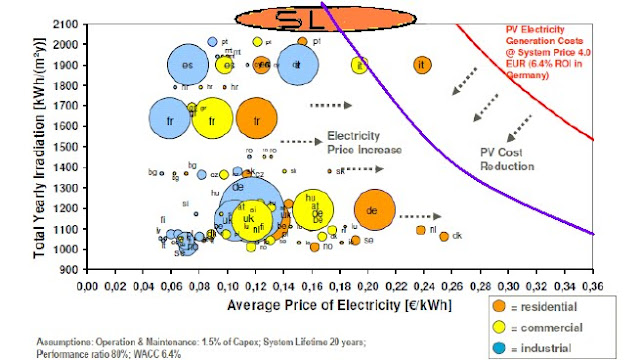
Coal Price

Increasing rapidly like Oil Price
Average Price of Electricity with Solar panel cost at $1/Wp as of now 2010 Violet curve
Saturday, March 30, 2013
Feasibility of solar electricity in Sri Lanka | Features
Feasibility of solar electricity in Sri Lanka | Features

Thursday, February 21, 2013
Saturday, February 9, 2013
Wednesday, February 6, 2013
Sunday, February 3, 2013
Saturday, February 2, 2013
Thursday, January 31, 2013
Wednesday, January 30, 2013
Saturday, January 5, 2013
Sunday, December 30, 2012
Solar PV’s 44% Efficiency Record, Thanks To NREL & Solar Junction
Switch to HTML mode and paste the embed code over this text
Saturday, December 29, 2012
Friday, December 14, 2012
Monday, November 26, 2012
Thursday, November 1, 2012
chandigarh_solar_city_master_plan.pdf (application/pdf Object)
chandigarh_solar_city_master_plan.pdf (application/pdf Object)
In India, it is seen that every year there is an increase of 20-30% in energy requirement in the residential sector and 8-10% increase in commercial sector; leading to a situation where there are both, energy as well as peak deficits. In case of Chandigarh, as per Department of Environment, Chandigarh Administration, per capita electricity consumption has been reported as 1162 kWh in 2006-07. The projections shows gradual increase in per capita electricity consumption of the city and might be 1246 kWh in 2008. The total electricity consumption of the city has been reported as 1157.5 MU during 2007-08. Taking in to account the exponentially increasing energy demand, it became obvious to Chandigarh Union Territory that this trend is not sustainable in the long run. It felt that measures such as reducing energy demands and switching from fossil fuel to renewable energy technologies would go a long way in addressing these concerns.
As has been the case with the wide-scale introduction of renewable energy technologies for a variety of applications in the country; Chandigarh UT took initiative to develop Chandigarh city as a solar city. The Chandigarh Renewable Energy, Science and Technology Promotion Society (CREST) had been given the mandate to prepare the plan to achieve this objective. In essence, the Solar City programme strives to integrate:
Energy conservation measures to reduce the energy demand, and
Utilization of locally available resources such as solar energy to meet these reduced energy demands
This Master Plan for Solar City is a dynamic document meant to change with time, experience, and need. The development of master plan has benefited from the active participation of CREST, Public Works Department, Municipal Corporation UT, Chandigarh Administration, Municipal Water Supply Department, Forest Department, power utilities, electricity department of Chandigarh Administration; and other agencies with energy-related responsibilities.
The whole exercise of developing a Master Plan for making Chandigarh a solar city has been a collaborative endeavour along with all the major stakeholders in the city. Developing the city as a solar city requires an integrated urban planning approach, which simultaneously involves reducing reliance on fossil fuels by the application of energy conservation and efficiency measures and by replacing/complementing the
In India, it is seen that every year there is an increase of 20-30% in energy requirement in the residential sector and 8-10% increase in commercial sector; leading to a situation where there are both, energy as well as peak deficits. In case of Chandigarh, as per Department of Environment, Chandigarh Administration, per capita electricity consumption has been reported as 1162 kWh in 2006-07. The projections shows gradual increase in per capita electricity consumption of the city and might be 1246 kWh in 2008. The total electricity consumption of the city has been reported as 1157.5 MU during 2007-08. Taking in to account the exponentially increasing energy demand, it became obvious to Chandigarh Union Territory that this trend is not sustainable in the long run. It felt that measures such as reducing energy demands and switching from fossil fuel to renewable energy technologies would go a long way in addressing these concerns.
As has been the case with the wide-scale introduction of renewable energy technologies for a variety of applications in the country; Chandigarh UT took initiative to develop Chandigarh city as a solar city. The Chandigarh Renewable Energy, Science and Technology Promotion Society (CREST) had been given the mandate to prepare the plan to achieve this objective. In essence, the Solar City programme strives to integrate:
Energy conservation measures to reduce the energy demand, and
Utilization of locally available resources such as solar energy to meet these reduced energy demands
This Master Plan for Solar City is a dynamic document meant to change with time, experience, and need. The development of master plan has benefited from the active participation of CREST, Public Works Department, Municipal Corporation UT, Chandigarh Administration, Municipal Water Supply Department, Forest Department, power utilities, electricity department of Chandigarh Administration; and other agencies with energy-related responsibilities.
The whole exercise of developing a Master Plan for making Chandigarh a solar city has been a collaborative endeavour along with all the major stakeholders in the city. Developing the city as a solar city requires an integrated urban planning approach, which simultaneously involves reducing reliance on fossil fuels by the application of energy conservation and efficiency measures and by replacing/complementing the
Saturday, October 27, 2012
Solar Photovoltaics | HeatSpring Magazine Solar Photovoltaics | HeatSpring Magazine Residential Solar PV Design 101 http://blog.heatspring.com/category/solar-photovoltaics/
Solar Photovoltaics | HeatSpring Magazine
In this guide you will learn
1. Solar Basics: Power, Energy, Current, Resistance, Circuits,
Irradiance, Irradiation, Azmith, Horizontal Tilt, Declincation, Voc,
Vmp, Imp, Isc, Temperature and Voltage Relationship, Irradiance
and Current Relationship
2. How to Size an Array based customer constraints and site
constraints and how to estimate power production.
3. How to Design and Size Grid-Connected Solar PV Inverter, Size
Strings and Size Conductor
In this guide you will learn
1. Solar Basics: Power, Energy, Current, Resistance, Circuits,
Irradiance, Irradiation, Azmith, Horizontal Tilt, Declincation, Voc,
Vmp, Imp, Isc, Temperature and Voltage Relationship, Irradiance
and Current Relationship
2. How to Size an Array based customer constraints and site
constraints and how to estimate power production.
3. How to Design and Size Grid-Connected Solar PV Inverter, Size
Strings and Size Conductor
Thursday, October 25, 2012
Saturday, October 20, 2012
Sunday, September 30, 2012
Subscribe to:
Posts (Atom)